
McLeod Probate Division
McLeod probate cases are handled by McLeod County District Court. The official court structure gives the district court original jurisdiction over probate cases, along with civil, family, juvenile, criminal, and traffic matters. Probate hearings can appear on the public daily calendar with case numbers using the `43-PR` format, courtroom or remote hearing location, date and time, judicial officer, hearing type, party role, and case number.
The Minnesota Judicial Branch probate guide describes probate as the court process for giving authority to transfer a decedent's property.
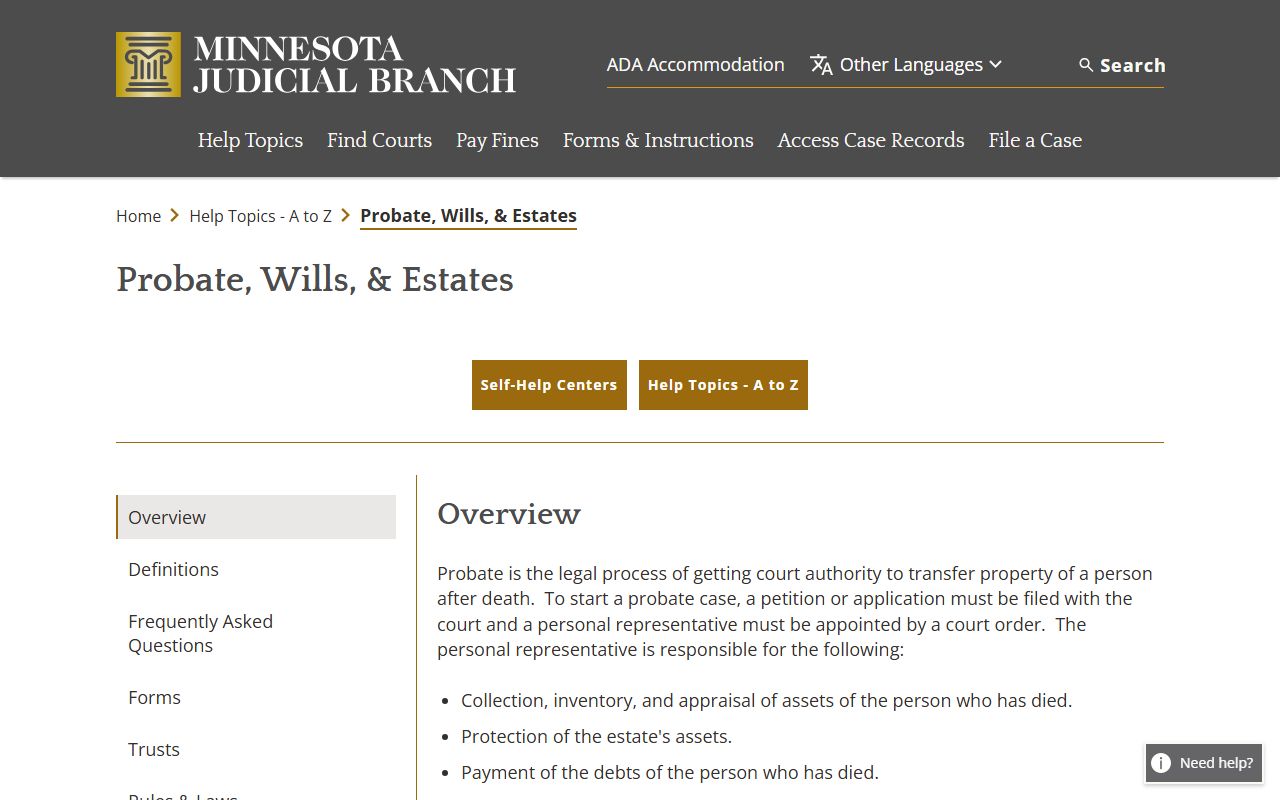
That statewide guide fits McLeod probate records because the local probate division operates inside Minnesota District Court.
Probate records can include petitions or applications, wills, orders appointing a personal representative, inventories, accountings, notices, affidavits, claims, letters, receipts, and closing documents. Guardianship and conservatorship files can include petitions, annual reports, accountings, medical or capacity information, and orders about a protected person's care or property. Not every document in those files is public or remotely available.
Probate Terms Defined
Probate records use terms that are easy to misread in a case search. A short definition box helps separate estate administration from guardianship or conservatorship matters.
- Testator
- A person who made a will.
- Personal representative
- The person appointed by the court to collect assets, pay debts, and distribute the estate.
- Intestate
- Dying without a valid will.
- Informal probate
- A less complicated probate process that can proceed without a judge hearing.
- Guardianship
- A court case about personal care and decision-making for a protected person.
- Conservatorship
- A court case about managing money or property for a protected person.
Search McLeod Probate in MCRO
MCRO is the online search channel for public Minnesota district court records, including McLeod probate records when the case or document is available remotely. Probate users can start with Case Search by name or case number, Document Search by case number, or Hearing Search for probate hearing dates. Public documents in formal probate, other probate, guardianship/conservatorship, and trust cases filed on or after July 1, 2015 may be available online, subject to Rule 8 and document availability.
- Open MCRO Case Search and search the decedent, petitioner, protected person, or case number.
- Limit the court location to McLeod County if the search returns too many statewide results.
- Use Document Search when the `43-PR` case number is known and public documents may be online.
- Use Hearing Search to confirm courtroom, remote hearing status, judge, date, and hearing type.
- Contact McLeod Court Administration when older files, certified copies, or restricted documents are needed.
The access-channel sweep for McLeod probate records is broader than one portal. Online search is available through MCRO. In-person access goes through Court Administration at the courthouse. Phone routing for probate estates is (320) 864-1278. Mail copy requests can use the statewide court copy request path or a written letter when no McLeod-specific form is available. Older files and courthouse-only documents require staff assistance.
| Access channel | Use it for | Limit |
|---|---|---|
| MCRO Case Search | Names, case numbers, and public case summaries | Not every document is online. |
| MCRO Document Search | Public documents by case number | Requires the case number. |
| MCRO Hearing Search | Probate hearing date, location, judge, and hearing type | Search results are not certified records. |
| Court Administration | Certified copies, older files, access questions, and restricted-document review | Some documents may be non-public. |
McLeod Probate Contact
There is one local probate court channel for McLeod County: the Probate Division of McLeod County District Court. Court Administration handles the file, the probate estates phone line, and copy routing. Guardianship and conservatorship calls use a split by last name, which is useful when the case is not a decedent's estate.
Probate hearings on the sampled daily calendar used the same court calendar structure as other district court cases. A probate entry may show the party name, Courtroom 1, Courtroom 2, Courtroom 3, or Zoom or Remote Hearing, the hearing date and time, judicial officer, hearing type, party role, and a case number such as `43-PR-26-660`. That calendar entry is a hearing notice, not the full probate file.
Probate Division of McLeod County District Court
McLeod County Courthouse
830 11th Street East, Suite 106
Glencoe, MN 55336
Probate estates: (320) 864-1278
Guardianship/conservatorship A-K: (320) 864-1545
Guardianship/conservatorship L-Z: (320) 864-1278
Monday-Friday, 8:00 a.m.-4:30 p.m.
McLeod Probate Fees
Probate fees in McLeod County follow the district court fee schedule. The first-paper fee applies to estate, trust, guardianship, and conservatorship filings. Copy fees apply when a person needs certified letters, a certified order, or another authenticated probate document.
A filing fee is not the same as a copy fee. The first-paper fee starts the probate, trust, guardianship, or conservatorship case. A certified copy fee applies later when someone needs an authenticated order, letter, judgment, or other filed document. Plain copies may be free, but a bank, title company, agency, or another court may require certification.
| Item | Amount |
|---|---|
| Estates, trusts, guardianships, and conservatorships first paper | $315 |
| Deposit of will for safekeeping | $27 |
| Certified copy | $14 |
| Exemplified and certified copy | $28 |
| Uncertified copy | $0 |
Informal and Formal Probate
Informal probate is used for less complicated estates and can proceed without a judge hearing. Formal probate is before a judge and is used when there are disputes or complications. A probate case typically starts with an application or petition and court appointment of a personal representative. That person collects, inventories, and appraises assets; protects estate property; pays debts; and distributes what remains.
Informal probate may be rejected when the estate is insolvent, interested parties are unknown, the original will is missing, the will is disputed, vulnerable persons need protection, distribution differs from the will, or administration is complex. Probate can be filed after 120 hours, or five days, from death and no later than three years after death. After three years, a decree of descent may be needed.
Minnesota resident probate is generally filed in the county where the decedent was domiciled. Nonresident probate is generally filed in a county where the person owned property. That filing rule matters in McLeod County when a person died elsewhere but owned real estate or other property in McLeod County, or when a McLeod resident had property in another county.
The Judicial Branch probate FAQ explains small-estate and timing rules for Minnesota probate cases.
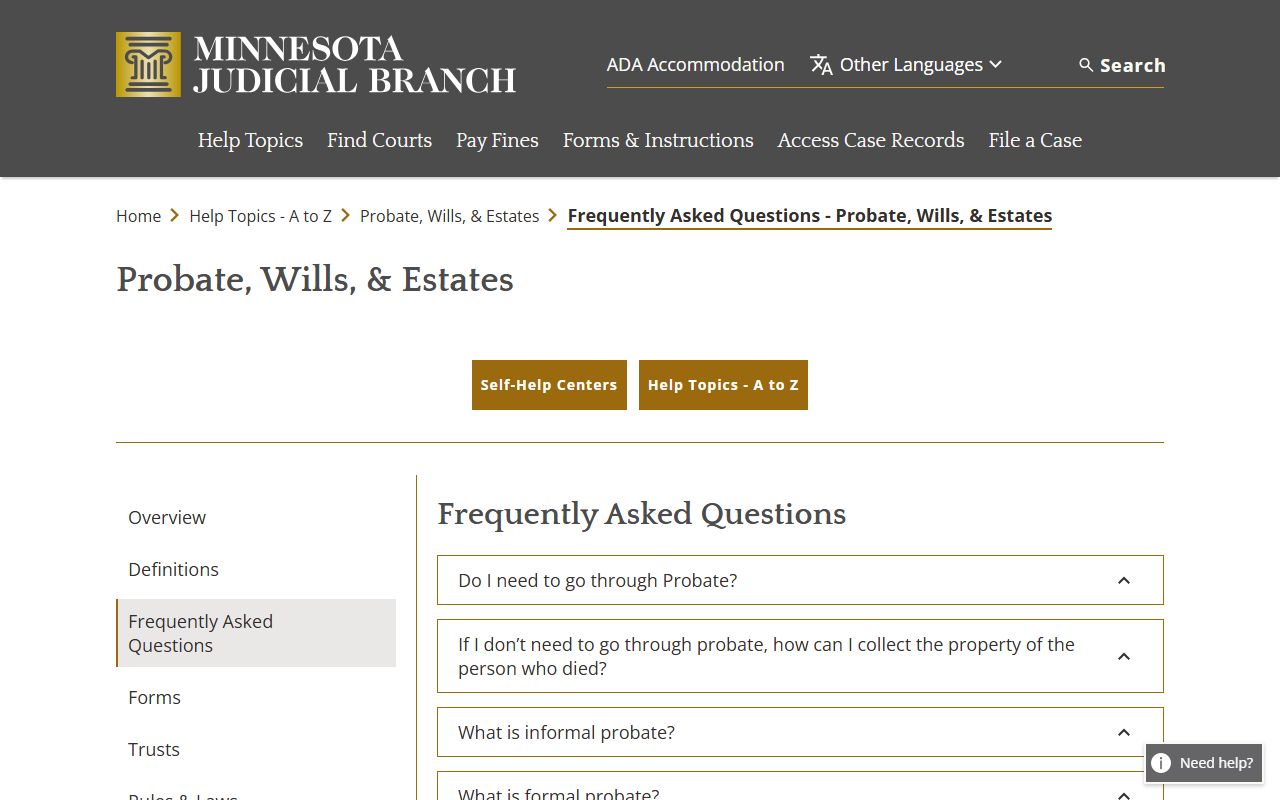
The FAQ is useful for McLeod probate searches because it explains when a court file may not exist at all.
Small Estates and Restricted Records
Probate is generally not needed when the decedent owned no real estate in their name alone and personal property in their name alone is not worth more than $75,000. An Affidavit for Collection of Personal Property may be used when the estate is under that amount, there is no solely owned or tenancy-in-common real estate, at least 30 days have passed, and no personal-representative application has been filed. The affidavit is taken to the asset holder and is not filed with the court.
Guardianship, conservatorship, trust, and probate files can contain sensitive medical, financial, or minor information. A case may appear publicly while specific documents remain non-public. Adoption records are confidential under Minnesota law and should not be treated as public probate or family records.
Restricted probate documents can also be affected by Rule 8 remote-access limits and General Rule of Practice 11 restricted identifiers. Social Security numbers, financial account numbers, taxpayer identifiers, and some medical or protected-person details should not be exposed in public filings. When a public index exists but the requested document is missing, the next step is to ask Court Administration whether the item is courthouse-only, sealed, confidential, or not part of the file.
Guardianship and conservatorship records need special care because the file may concern a living adult or minor. A public docket can confirm that a case exists, but annual reports, medical exhibits, financial account details, and protected-person addresses may be withheld or redacted. Estate files can have similar limits when restricted identifiers or confidential financial source documents were filed. For certified probate copies, identify the order, letters, or filing by case number before contacting McLeod Court Administration.
The Minnesota adoption confidentiality statute is one of the rules that limits access to certain court-connected family records.
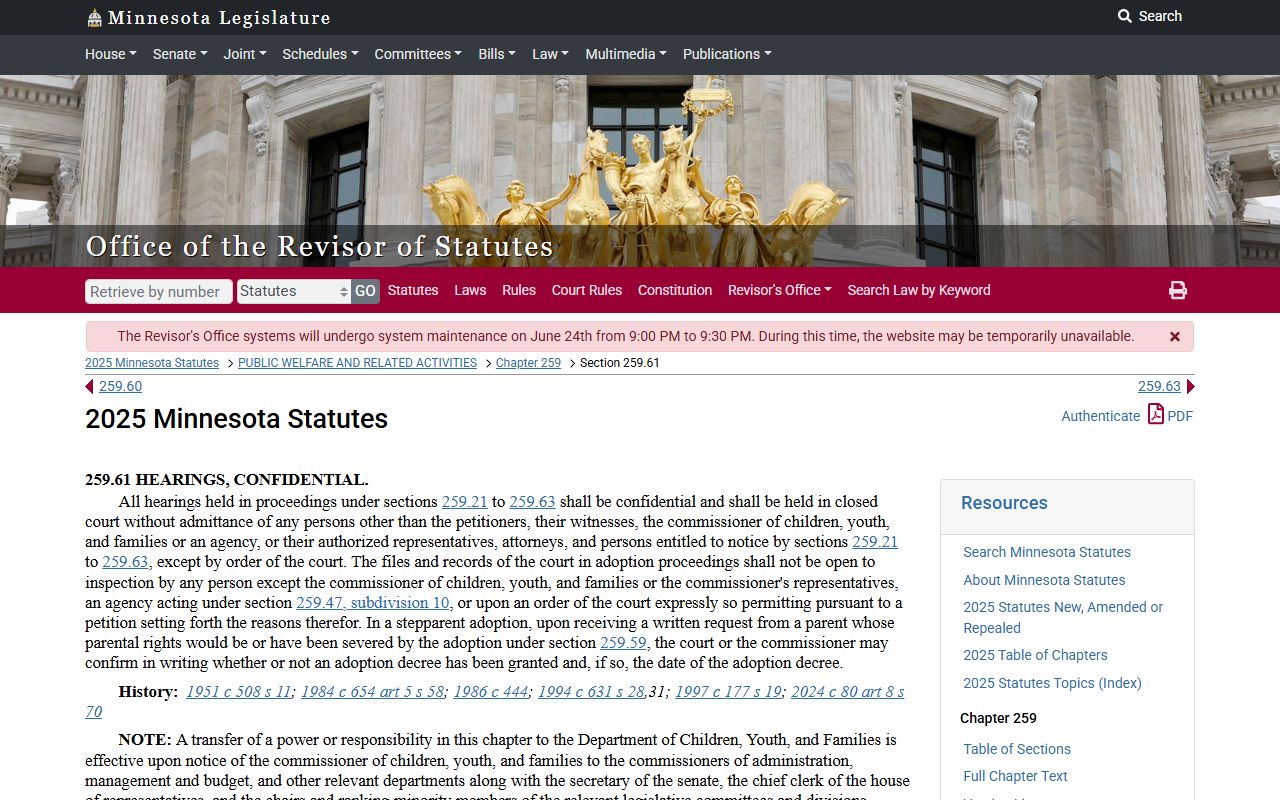
That restriction is separate from ordinary estate access, but it is part of the public-record boundary around probate-adjacent filings.
Note: A missing probate case in MCRO can mean no probate was filed, the case is older, the document is not remote, or access is restricted.