
McLeod Court Administrator
Minnesota uses court administration rather than a separate elected district clerk for McLeod County court case files. The court administrator is part of the Minnesota Judicial Branch and the First Judicial District. The Rules of Public Access define court administrator broadly, including the district court administrator who maintains case records and manages local court operations.
The Judicial Branch overview identifies court administrators as part of Minnesota's district court system.
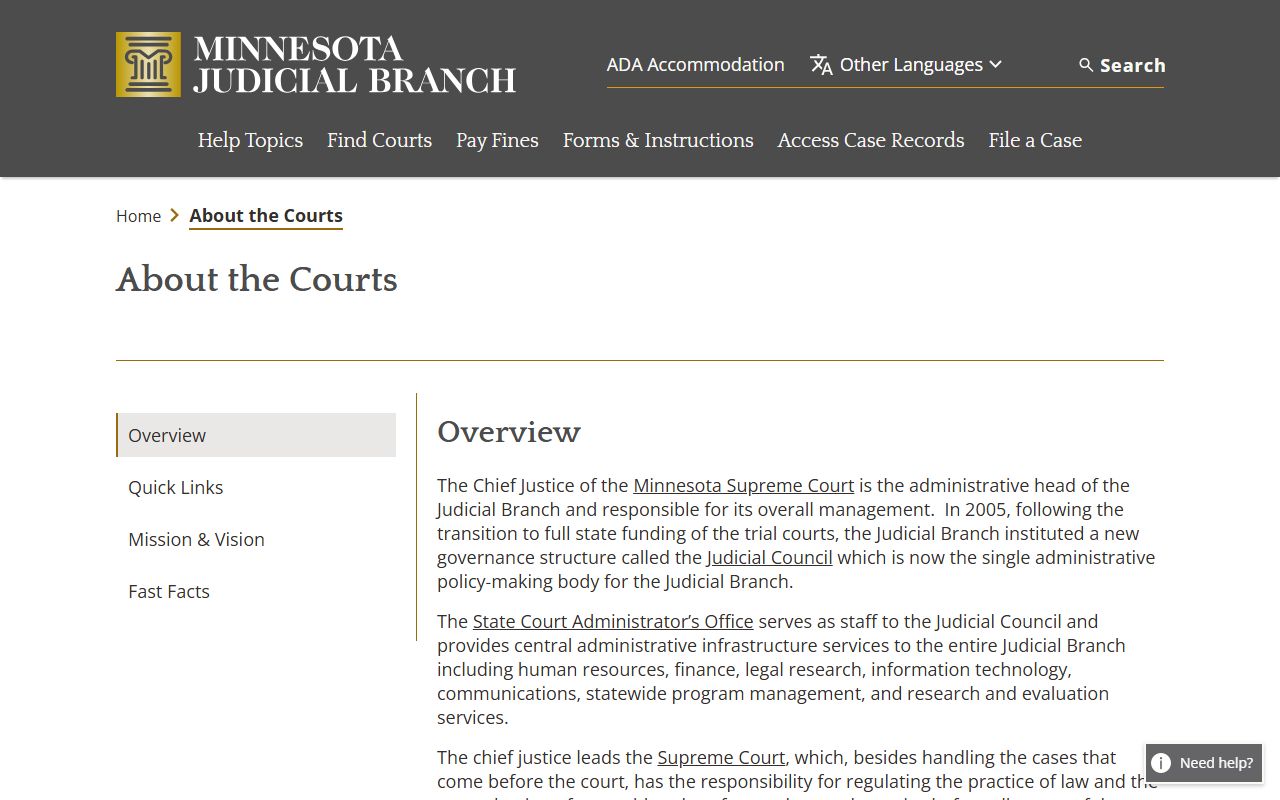
That statewide structure is why the McLeod County page should refer to Court Administration rather than an elected clerk office.
McLeod Court Administration is the local custodian for district court case processing, but it is not a county department that handles every public record. Its records work is tied to case files, hearing calendars, court documents, filings, fees, fines, and certified copies. A request for a sheriff report, jail booking record, active warrant list entry, marriage certificate, real estate document, or driver record should be sent to the office that created or maintains that record.
McLeod Court Administration
Court Administrator: Karen V. Messner
McLeod County Courthouse
830 11th Street East, Suite 106
Glencoe, MN 55336
(320) 864-1281
Alternate main: (320) 864-1513
Fax: (320) 864-5905
Monday-Friday, 8:00 a.m.-4:30 p.m.
McLeod Court Phone Routing
Court Administration has unusually detailed phone routing by case type and last-name range. Use the main line when the case type is unknown. For a known case category, the direct line can reduce transfers. These lines serve records questions, filing questions, calendaring issues, jury routing, collections, and payment-center referrals.
- Civil, conciliation, family, and child support: A-E (320) 864-1545, F-O (320) 864-1280, P-Z (320) 864-1539.
- Probate estates: (320) 864-1278.
- Guardianships and conservatorships: A-K (320) 864-1545, L-Z (320) 864-1278.
- Criminal: A-L (320) 864-1282, M-Z (320) 864-1283.
- Traffic: A-L (320) 864-1760, M-Z (320) 864-1761.
- Fines and Minnesota Court Payment Center: (651) 281-3219 or (800) 657-3611.
- Scheduling, depositions, and ITV room: (320) 864-1389.
Child protection and adoption calls use mother's last name routing: A-K at (320) 864-1760 and L-Z at (320) 864-1278. Juvenile calls use the same A-K and L-Z split. Commitments route A-K to (320) 864-1539 and L-Z to (320) 864-1278. Jury manager lines include (320) 864-1278, (320) 864-1545, and (320) 864-1280, with a separate jury message line at (320) 864-1279.
This routing system is useful for records access because a case may be public but still need the correct case-type desk. For example, probate estates use one line, guardianship and conservatorship matters use a split, criminal uses a different split, and traffic uses the traffic desk or the Minnesota Court Payment Center depending on the task.
Request McLeod Court Copies
Many public documents can be downloaded free from Minnesota Court Records Online when the document is available remotely. Certified copies, exemplified copies, sealed-case access requests, older records, and documents not posted online require Court Administration. Certified copies are used when a court, agency, employer, school, or licensing body needs an authenticated court document.
- Search MCRO first by name, case number, citation number, attorney, or judgment debtor, depending on the record type.
- Record the case number, party names, document title, and county location shown in the case detail.
- Download the document from MCRO if a free public copy is available and no certification is needed.
- Contact McLeod Court Administration or mail a statewide copy request or written letter when the document is not online.
- Specify plain, certified, exemplified, or exemplified and certified copy type, then include the required fee when a fee applies.
Copy channels include MCRO downloads, in-person courthouse requests, mailed copy requests or written letters, eFile and eServe where appropriate, and sealed-record identity review. Court Administration can also explain when a public document is available only at a courthouse terminal or through the State Law Library, rather than through remote MCRO access.
Copy Request Details
A court copy request works best when it identifies the case with enough detail for staff to locate the file. The Judicial Branch says many in-person requests can be completed the same day, but off-site records can take longer. Confidential or sealed matters may require an identity or access process before any copy is released.
| Field | Required | Notes |
|---|---|---|
| Case number | Best if known | McLeod case numbers often start with 43, such as 43-CR, 43-CV, 43-FA, or 43-PR. |
| Party names | Yes | Use full names and date of birth when the case type allows it. |
| Case type | Helpful | Civil, criminal, family, probate, traffic, juvenile, or judgment. |
| Document title | Yes | Examples include decree, order, judgment, complaint, disposition, or register of actions. |
| Copy type | Yes | Plain, certified, exemplified, or exemplified and certified. |
| Delivery method | Yes | In person, mail, or eFiling channel where appropriate. |
For sealed or confidential cases, the request should explain the requester's relationship to the case and why access is claimed. Court staff may need to verify identity or authorized access before releasing anything. For ordinary public cases, a complete case number and document title are usually enough to avoid a slow name-only search.
McLeod Court Fee Table
McLeod County District Court fees distinguish free plain copies from authenticated court copies and filings. The court fee schedule also lists local filing fees for case starts, motions, expungements, probate, and will deposits.
| Item | Amount |
|---|---|
| Certified copy of civil or criminal instrument | $14 |
| Certified MNCIS courthouse printout or screen print | $14 |
| Exemplified and certified copy | $28 |
| Uncertified copy, printout, or screen print | $0 |
| Case management report, 1-50 pages | $5 |
| Case management report, 50+ pages | $25 per 50 pages or part |
| Civil first paper filed | $315 |
| Conciliation first paper filed | $70 |
| Dissolution of marriage | $395 |
| Probate first paper | $315 |
The McLeod District Court fee schedule is the official source for copy and filing costs.
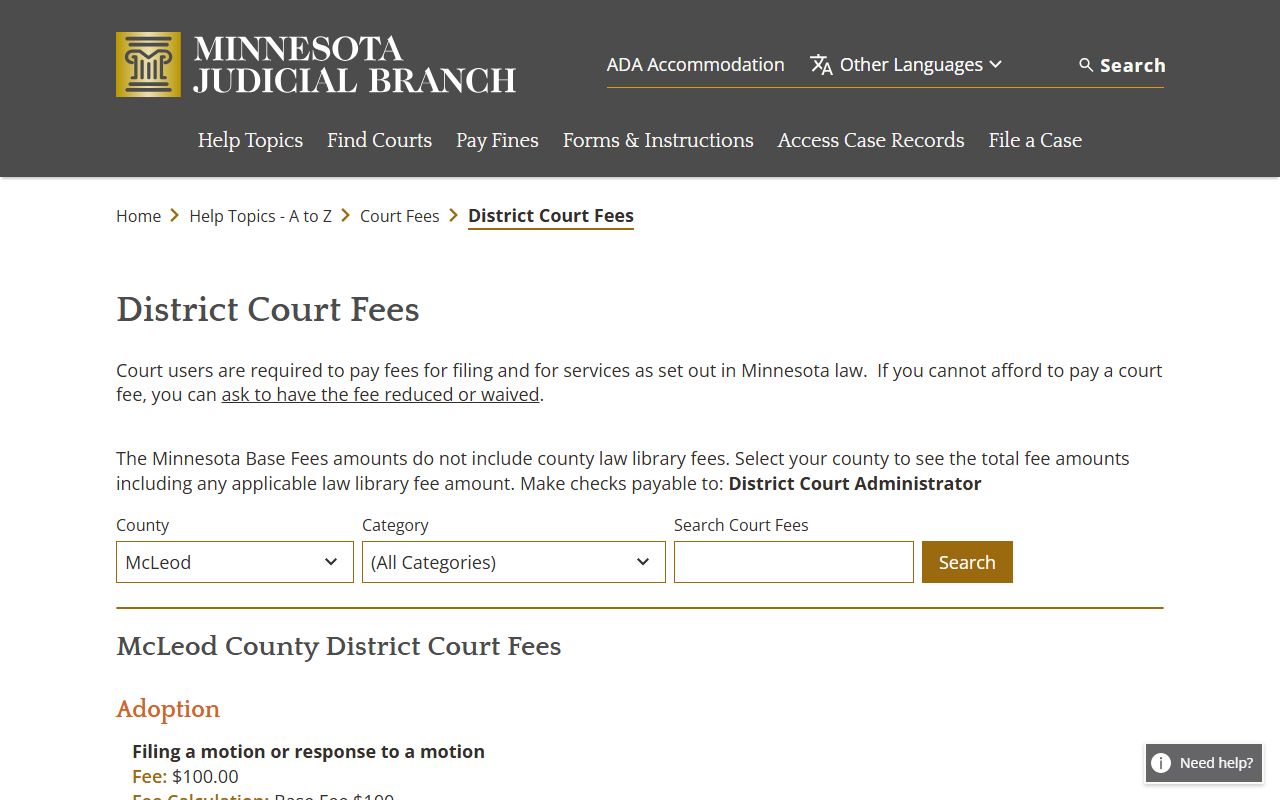
Those fees apply to court records and court filings, not to sheriff reports or county vital records.
The fee schedule also lists criminal expungement at $315 and deposit of wills for safekeeping at $27. Those items show why court copy and filing requests should be separated from general county public data requests. A person seeking to seal a criminal case files in district court under the Minnesota expungement process, while a person seeking a sheriff incident report uses the Sheriff's written public data request channel.
MCRO vs Courthouse Records
MCRO is the main online access point for McLeod County district court records, but it is not a certified record source. Public records available on courthouse terminals or at the State Law Library are not always available remotely. Pending criminal, traffic, and petty misdemeanor cases without conviction may be hidden from defendant-name searches, although a case-number search may still work.
- Use MCRO Case Search for names, case numbers, citations, and attorney searches.
- Use MCRO Document Search when the case number is known and the public document is online.
- Use MCRO Hearing Search for court date, courtroom, judicial officer, and hearing type.
- Use Judgment Search for debtor-name judgment records.
- Contact Court Administration for certified copies, sealed access, older files, or missing documents.
MCRO limits are practical, not just technical. Domestic abuse and harassment case types, CHIPS and certain juvenile delinquency case types, public documents in civil commitment case types, party street addresses, comment fields, and pending criminal or traffic cases without conviction can be limited online. A missing online result should be checked against the case number, case type, filing date, and courthouse access channel before assuming no record exists.
The Public Access Rule definitions explain case records, administrative records, and the court administrator role.
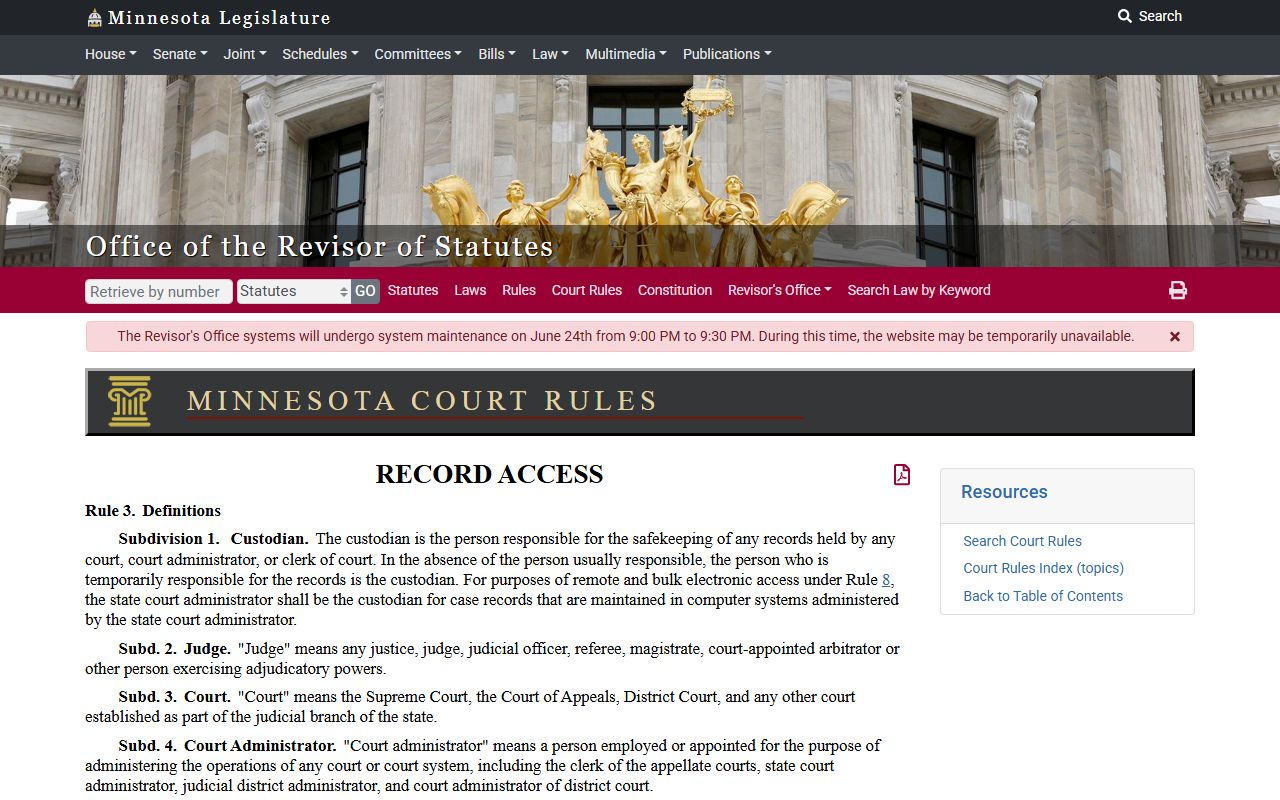
The rule language supports the practical distinction between public court access and local court-administration handling.
Records Court Does Not Provide
Court Administration does not provide birth, death, marriage, immigration, real estate, or Recognition of Parentage records. Marriage certificates and licenses route to McLeod County vital-record offices. Sheriff reports, jail booking data, warrants, gun permits, and law-enforcement reports route to the Sheriff's Office and its written public data request process. Driver records route to Minnesota DPS/DVS.
| Record needed | Correct channel | Reason |
|---|---|---|
| Certified divorce decree | McLeod Court Administration | Divorce is a district court family case. |
| Marriage certificate | McLeod Auditor-Treasurer or issuing county | Marriage certificates are county vital records. |
| Active warrant list or sheriff report | McLeod County Sheriff's Office | Law-enforcement data is outside the court file. |
| Driver history | Minnesota DPS/DVS | Licensing records are state driver records. |
| Real estate recording | County recording office | Land records are not district court case records. |
Note: The courthouse may have a case file that mentions another record, but that does not make Court Administration the custodian of the outside record.